




















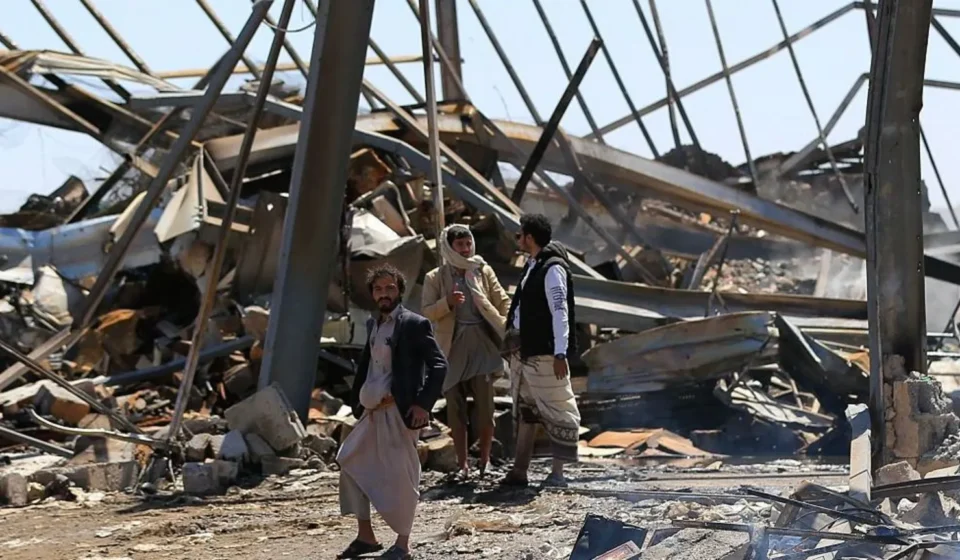
Houthi advance threatens Red Sea shipping, pressure to global economy
The withdrawal of Saudi-backed Yemeni forces from positions near Bab al-Mandab has strengthened the rebels’ strategic leverage, raising concerns over oil exports, maritime security and the economic consequences of a prolonged regional conflict.
The latest advance by Yemen’s Houthi movement has increased the risks facing one of the world’s most important maritime corridors, raising concerns about further disruption to international trade and energy supplies. Saudi-backed forces aligned with Yemen’s internationally recognised government have withdrawn from positions near the Bab al-Mandab Strait to reinforce their defence of Aden, giving the Iran-aligned group greater influence over the southern entrance to the Red Sea.
In an analysis published on 17 November, BBC security correspondent Frank Gardner warned that the military setback could create further economic pressure at a time when the conflict involving the United States, Israel and Iran has already disrupted shipping through the Strait of Hormuz. The potential consequences extend beyond Yemen, particularly for Gulf oil exporters and economies dependent on maritime trade between Asia and Europe.
However, the distinction between controlling territory overlooking a maritime chokepoint and exercising complete control over the waterway remains important. Reuters reported that Yemeni government-aligned forces withdrew from the Dhubab Airport and Bab al-Mandab area on 15 November. A UK maritime-security assessment published on 12 November said control of the approaches and key islands remained contested and that complete or stable control had not been independently confirmed.
Bab al-Mandab connects the Red Sea with the Gulf of Aden and the Indian Ocean. It is a critical passage for vessels travelling between Asian markets and Europe through the Suez Canal. The BBC estimates that the strait normally handles around 12% of global trade, with approximately 70 to 150 ships passing through daily.
Its strategic importance has increased because of the disruption in the Strait of Hormuz, through which a substantial share of global oil and energy shipments normally passes. The conflict involving Iran has severely restricted traffic through that route, increasing the importance of alternative export and shipping corridors.
The two chokepoints serve different geographical functions, but simultaneous disruption can compound pressure on energy markets and supply chains. Longer shipping routes, higher insurance premiums and uncertainty over access to export terminals can increase costs for businesses and consumers.
Saudi Arabia developed an alternative to exporting oil through the Persian Gulf by using its East-West Pipeline to transport crude across the country to the Red Sea port of Yanbu. The route became particularly important after the disruption of shipping through Hormuz.
However, the alternative has also faced security threats. The BBC reported that the pipeline was hit by drones after the breakdown of a fragile truce between Saudi Arabia and the Houthis in July. Separately, Reuters has reported Houthi attacks on Saudi ports, airports and facilities belonging to state oil company Saudi Aramco, including the Yanbu export hub.
These developments have increased the vulnerability of Saudi Arabia’s western export infrastructure. Even if the pipeline continues to operate, threats to Red Sea ports and nearby shipping routes could undermine the effectiveness of the alternative corridor.
The distinction between attacks on pipeline infrastructure and attacks on export facilities is important. The available reporting does not establish that the Houthis were responsible for every drone strike affecting Saudi energy infrastructure.
The withdrawal from the Red Sea coast has shifted attention towards Aden, the temporary seat of Yemen’s internationally recognised government. The city is a major port and an important political and military centre for forces opposing the Houthis.
Nicholas Hopton, a former British ambassador to Yemen and Iran, told the BBC that the decision to prioritise Aden’s defence at the expense of other territory indicated a deteriorating military position for the Saudi-backed government. He warned that a Houthi capture of the city could deepen the regional crisis and add to instability in the global economy.
Mohammed al-Basha, founder of the US-based risk advisory firm Basha Report, offered a more cautious assessment. He told the BBC that capturing Aden would be difficult because of its population density and the exposure of advancing Houthi forces to air power. He suggested that the group could instead seek to exploit divisions among southern factions and pressure the government into a negotiated surrender.
The difference between these assessments highlights the uncertainty surrounding the next stage of the conflict. A direct assault on Aden could carry substantial military and humanitarian costs, while continued pressure on government forces could weaken the city’s defences without an immediate large-scale offensive.
The Houthi advance also has implications beyond Yemen’s borders. Former British defence attaché to Yemen Colonel Iain Smailes told the BBC that greater control over the western coastline could improve the group’s ability to smuggle weapons and ammunition from Iran, the Horn of Africa and other locations.
Such developments could strengthen the movement’s regional reach and create additional security concerns for countries along the Red Sea and the Gulf of Aden. The maritime corridor is particularly sensitive because commercial shipping, energy transport and regional security operations depend on relatively predictable access.
The US Maritime Administration has warned that Houthi attacks on commercial vessels have resumed and that ships operating in the Red Sea, Bab al-Mandab and surrounding waters face elevated risks. Its November advisory also noted the group’s declared restrictions on Saudi-affiliated shipping.
The economic consequences will depend on whether the Houthis expand their attacks, how Saudi Arabia responds and whether commercial shipping operators continue to use the Red Sea route. The UK Maritime Trade Operations and Joint Maritime Information Centre assessment published on 12 November described the threat level in the southern Red Sea and Bab al-Mandab as substantial, while noting that commercial traffic remained open at reduced but relatively stable levels.
This suggests that the immediate risk is not necessarily a complete shutdown of the strait, but a sustained increase in uncertainty and operating costs. Shipping companies may divert vessels, insurers may raise premiums and energy exporters may face additional difficulties moving supplies to international markets.
For economies already dealing with higher energy costs and disrupted trade routes, prolonged instability could add to inflationary pressure. Higher transport and fuel costs can feed into food prices, industrial production and consumer spending, particularly in countries heavily dependent on imported energy and manufactured goods.
The Houthi advance has therefore created a new strategic pressure point in a region already affected by the Iran conflict. Whether it develops into a wider maritime crisis will depend on the group’s military decisions, the ability of Saudi-backed forces to defend Aden and the response of international shipping operators. The central economic concern is not simply who controls the coastline, but whether the conflict makes one of the world’s most important trade corridors increasingly costly and dangerous to use.
Sources: BBC — Houthi rebel advance in Yemen may further destabilise global economy, Frank Gardner, 17 November 2026; Reuters — Yemeni government forces withdraw from area near Bab el-Mandeb Strait, Houthis in control, 15 November 2026; Reuters — After Yemen setback, Saudi Arabia replaces military commander, 16 November 2026; UK Maritime Trade Operations — Joint Maritime Information Center advisory update, 12 November 2026; US Maritime Administration — Advisory 2026-013: Houthi attacks on commercial vessels; United Nations Department of Political and Peacebuilding Affairs — Remarks to the Security Council on developments in Yemen, 15 September 2026.
