



















Myanmar crisis, floods and economic vulnerabilities dominate the regional agenda
RMRN Desk: Southeast Asia’s news agenda on September 29–30 is being shaped by three overlapping developments: the worsening humanitarian situation in Myanmar, severe flooding across Thailand and neighboring countries, and renewed pressure on regional economies from higher energy prices and global financial volatility. Across the region’s media, these stories are being framed less as isolated national events and more as evidence of the growing difficulty for ASEAN governments to manage problems that cross national borders.
Myanmar remains one of the most politically sensitive stories. Malaysia began repatriating nearly 1,500 Myanmar nationals on September 29 despite objections from the United Nations and human-rights organizations, which have warned that conditions in Myanmar remain unsafe because of the continuing conflict. Associated Press reported that 1,476 people, including women and children, were sent back under what Kuala Lumpur describes as a voluntary repatriation program, while rights groups have questioned whether vulnerable people were properly screened before removal. Malaysia says Myanmar should assume responsibility for its citizens and that the policy is connected to its wider effort to manage undocumented migration.
The framing of the Malaysian decision is particularly revealing. Malaysian official messaging emphasizes sovereignty, migration management and diplomatic responsibility, while international humanitarian organizations frame the same development around non-refoulement and the safety of returnees. The difference is not simply semantic: it reflects two competing understandings of the Myanmar problem. For Kuala Lumpur, the issue is increasingly connected to the practical burden of hosting a large displaced population; for humanitarian organizations, the continuing conflict means that return itself can constitute a protection risk.
The development also puts ASEAN in an uncomfortable position. Malaysia has been one of the regional actors attempting to maintain diplomatic engagement with Myanmar, while ASEAN has struggled to produce a political solution to the country’s conflict since the 2021 military takeover. Earlier ASEAN discussions have increasingly centered on whether engagement with Myanmar’s military-controlled authorities should continue through a more pragmatic approach. Reuters reported in August that Thailand’s prime minister had advocated “calibrated re-engagement” with Myanmar, reflecting a wider debate within Southeast Asia over whether isolation or engagement is producing meaningful results.
The humanitarian situation inside Myanmar adds another dimension. An airstrike near a market in Rakhine State reportedly killed at least 49 people and injured 58 others on September 28, according to the Associated Press, citing the Arakan Army and local rescue officials. The incident occurred in an area controlled by the Arakan Army and highlights the continuing violence between Myanmar’s military and ethnic armed organizations. The military has previously said its air operations target legitimate military threats, while opponents and local organizations have repeatedly accused it of causing civilian casualties.
Rakhine is particularly important for the wider Southeast Asian media narrative because developments there intersect with the Rohingya issue, Bangladesh’s border concerns and Malaysia’s refugee policy. The current coverage therefore links what might appear to be separate stories—Myanmar’s civil war, Malaysian deportations and regional refugee management—into a broader question about whether ASEAN can address the humanitarian consequences of the Myanmar conflict.
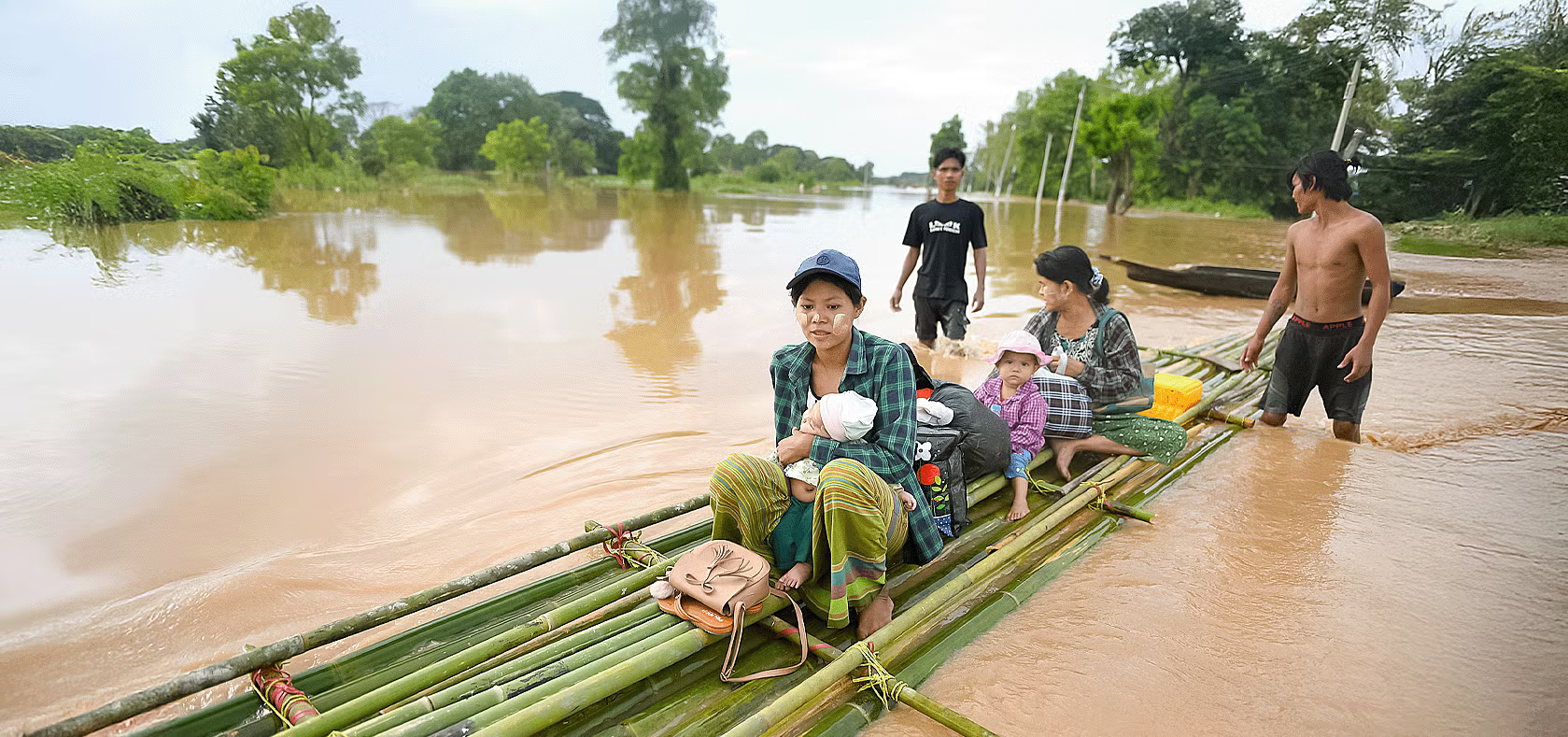
At the same time, extreme flooding has become another major regional story. Thailand has been particularly affected, with heavy rainfall since September 16 causing flooding across dozens of provinces. Reuters reported at least 23 deaths and estimated economic damage of about $367 million, while Bangkok received roughly 320 millimeters of rain in three days, close to the city’s normal monthly rainfall. The flooding has also disrupted operations at Suvarnabhumi Airport, with Thai Airways cancelling around 30% of flights amid staffing and baggage-handling problems.
Thai domestic coverage naturally emphasizes the government’s emergency response and the disruption to Bangkok’s residents and businesses. International coverage, however, has increasingly framed the disaster as a climate-resilience and urban-infrastructure problem. The government’s approval of an emergency aid package of around 4 billion baht, together with plans for a much larger long-term drainage project, has shifted part of the media discussion from immediate rescue to the question of whether Bangkok’s infrastructure is capable of dealing with increasingly severe rainfall.
The flooding is also being reported as a regional phenomenon rather than a purely Thai disaster. Reuters noted severe flooding and deaths in Myanmar, while Cambodia has also experienced widespread disruption. The simultaneous disasters reinforce an increasingly common Southeast Asian media narrative: extreme weather is becoming a shared regional risk, while disaster-management capacity remains primarily national.
The economic story provides another layer. Indonesia’s rupiah fell through the 18,000-per-dollar level on September 29, with Reuters linking the pressure to higher US Treasury yields and rising oil prices. Indonesia’s stock market also came under pressure, while other Southeast Asian markets and currencies weakened. The story illustrates how developments outside Southeast Asia—particularly higher energy prices and global financial conditions—are rapidly transmitted into the region’s economies.
This economic framing is important because Southeast Asia’s current vulnerabilities are not limited to politics and climate. The Asian Development Bank’s September outlook projects developing Asia and the Pacific to grow 5% in 2026, while warning that the prolonged Middle East conflict and elevated energy prices are creating additional uncertainty. For Southeast Asian economies that depend heavily on imported energy, the Middle East crisis is therefore becoming an indirect regional economic story.
The region’s longer-term economic narrative, however, remains more positive. Recent regional reporting highlights the rapid expansion of digital payments, with ASEAN’s digital-payment gross transaction value reaching about $1.41 trillion in 2025 and projected to rise substantially by 2030. This creates a contrasting narrative alongside the security and disaster stories: Southeast Asia is simultaneously confronting geopolitical and environmental vulnerabilities while becoming one of the world’s most rapidly digitizing consumer markets.
The difference in media framing across Southeast Asia is therefore becoming increasingly visible. Myanmar coverage is dominated by questions of conflict, refugees and ASEAN’s diplomatic limitations. Thailand’s flood coverage moves between immediate humanitarian concerns and questions about infrastructure and climate resilience. Indonesia’s financial coverage focuses on currency stability, global interest rates and energy costs. Regional economic reporting, meanwhile, highlights digitalization, trade and the continuing integration of Southeast Asian markets.
Taken together, the current Southeast Asian media landscape presents a region facing multiple forms of interconnected vulnerability. Political instability in Myanmar generates refugee and humanitarian pressures beyond its borders; extreme weather simultaneously affects several countries; and global energy and financial shocks quickly reach regional currencies, markets and consumers. Yet the media narratives remain largely national, with each country’s outlets emphasizing its own government’s responsibilities and domestic consequences.
The deeper regional story is consequently about the gap between shared problems and fragmented responses. ASEAN’s member states are increasingly exposed to the same humanitarian, environmental and economic pressures, but the political mechanisms for responding collectively remain limited. Myanmar remains the clearest example of this problem, while the simultaneous flooding and economic volatility demonstrate that the challenge extends well beyond the region’s traditional security disputes.
