




















California voters reject proposed one-time tax on billionaires
The defeat of Proposition 40 marks a setback for progressive efforts to tax extreme wealth, amid concerns over capital flight, business investment and the state’s ability to fund public services.
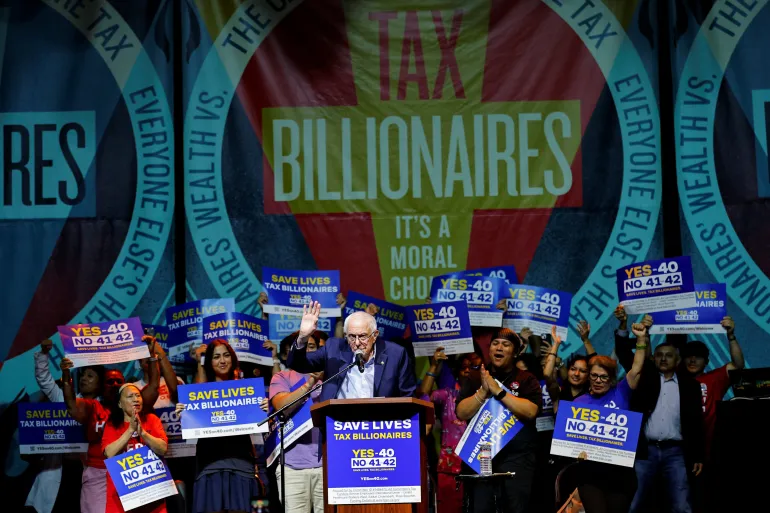
California voters have rejected a proposed one-time tax on billionaires, dealing a setback to a campaign led by progressive politicians to use wealth taxation to fund healthcare and other public programmes. The Associated Press projected the measure would fail during Tuesday’s US midterm elections, with opponents leading as approximately 60% of the votes had been counted.
The proposal, known as Proposition 40, would have imposed a one-time tax of 5% on the net worth of California residents whose assets exceeded $1 billion. With the “no” vote leading at 55.6%, against 44.4% for “yes”, the measure appeared headed for defeat, according to the results reported by Al Jazeera, citing the Associated Press, AFP and Reuters.
Supporters estimated that the tax could raise around $100 billion, with most of the proceeds earmarked for healthcare programmes. Education and food assistance were also expected to receive funding.
Proposition 40 was promoted by US Senator Bernie Sanders and other progressive politicians as a way to address economic inequality and provide additional resources for public services.
Democrats supporting the proposal argued that the revenue was necessary to help offset federal funding reductions under President Donald Trump’s One Big Beautiful Bill. The proposal also formed part of a wider debate over whether the wealthiest individuals should contribute more towards public expenditure.
Its rejection means California will not receive the projected revenue from the proposed levy. However, the vote does not resolve the broader question of how the state will address potential funding pressures affecting healthcare, education and food assistance.
Outgoing California Governor Gavin Newsom opposed Proposition 40, arguing alongside other critics that the tax could encourage wealthy individuals, technology entrepreneurs and businesses to leave the state.
Opponents warned that the departure of high-net-worth residents could reduce personal income-tax receipts and weaken investment and job creation. They also argued that the proposal could establish a precedent for more extensive taxation, potentially affecting assets beyond those of billionaires.
The campaign against the measure received substantial financial backing from wealthy business figures. Californian billionaires, including Google co-founder Sergey Brin, spent more than $250 million opposing the proposal, according to Al Jazeera’s report.
Critics also raised concerns that the tax could affect retirement accounts and become a starting point for broader taxation. These arguments formed a central part of the campaign against the measure.
The proposal exposed divisions within California’s Democratic leadership, labour unions and progressive movement. Although Sanders and other left-wing politicians backed the tax, Newsom’s opposition weakened the campaign’s political support ahead of the vote.
The defeat is particularly significant because it comes after Democrats made substantial gains in the 2026 midterm elections, securing majorities in both chambers of Congress. The result illustrates that the party’s broader electoral gains have not necessarily translated into support for every progressive economic policy.
Nevertheless, efforts to increase taxation on the ultrawealthy remain part of the Democratic Party’s national agenda. Incoming Senate Finance Committee Chairman Ron Wyden said on 4 November that the committee would intensify efforts to ensure billionaires paid what he described as their fair share and to hold tax evaders accountable.
California’s vote highlights a continuing policy dispute over how governments should tax extreme wealth without undermining investment, employment and the tax base.
Supporters of wealth taxes argue that concentrated private wealth can contribute more to public services and reduce economic inequality. Opponents question whether one-time levies on net worth could prompt capital flight, create valuation difficulties or discourage investment.
The California proposal offered a test of these competing arguments in a state with a substantial concentration of technology wealth. Its rejection does not establish that voters oppose every form of higher taxation on wealthy individuals, but it demonstrates that a specific proposal can face significant resistance even when its stated purpose is to finance public services.
The immediate consequence is that the proposed $100 billion revenue stream will not materialise through Proposition 40. The broader debate over the taxation of billionaires, however, is likely to remain part of US economic and political discussions as lawmakers consider how to finance public services and distribute the costs of government.
Sources
- Al Jazeera — California voters reject billionaire tax
- Associated Press — Election projection on California Proposition 40, as cited by Al Jazeera.
- Reuters and AFP — Reporting on the California billionaire-tax campaign, as cited by Al Jazeera.
