












Houthi advance towards Aden could revive Yemen’s southern separatist movement
The growing threat of a Houthi advance towards Aden is increasing the strategic importance of Yemen’s Southern Transitional Council (STC), a separatist movement seeking an independent state in the country’s south. Analysts say the group could regain political and military influence as forces aligned with Yemen’s internationally recognised government struggle to contain the latest Houthi offensive.
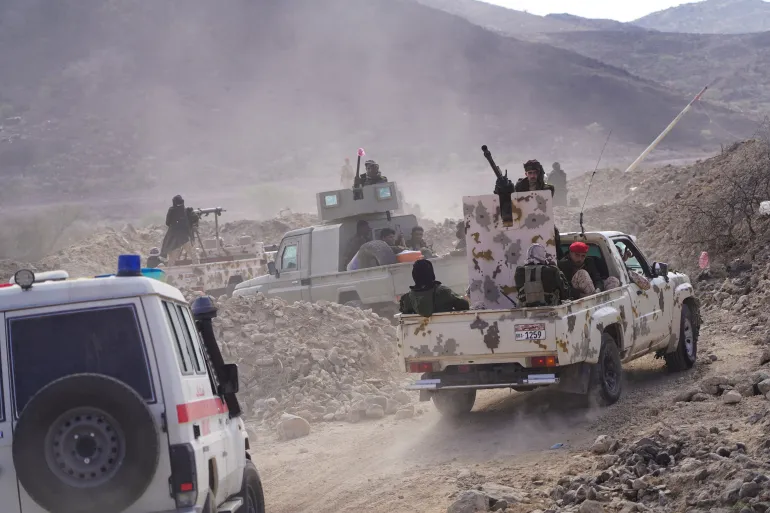
The Houthis, also known as Ansar Allah, have moved to within approximately 60 kilometres (37 miles) of Aden, the government’s de facto capital. Following the withdrawal of government-aligned forces from key positions along Yemen’s Red Sea coast, factions linked to the STC have stepped up mobilisation efforts to defend Aden and surrounding southern areas.
The developments come months after a Saudi-backed military campaign weakened the separatist movement and exposed divisions among forces opposed to the Houthis.
Separatists seek a renewed role in southern defence
The STC seeks an independent state in southern Yemen and is widely believed to receive support from the United Arab Emirates. An announcement that the organisation had disbanded was made at the beginning of 2026 following the Saudi-backed campaign against it. However, senior members rejected the dissolution, describing it as null and void.
The group’s position has become more significant as the Houthi offensive advances towards the south.
Aidarous al-Zubaidi, the STC’s leader, has launched a mobilisation campaign across southern Yemen, preparing forces to defend Aden, Lahij and al-Dhalea.
Amr al-Bidh, a special representative of the STC president, argued that the earlier campaign against southern separatists had weakened one of the most effective forces opposing the Houthis.
“In January, the most effective anti-Houthi force in Yemen was taken apart by decisions in Riyadh, not by the Houthis,” al-Bidh told Al Jazeera.
He also said that STC forces would need operational autonomy to defend the southern front effectively, arguing that local forces should have a greater role in decisions concerning their own security.
A divided anti-Houthi coalition
Despite the STC’s renewed mobilisation, its ability to stop the Houthi advance remains uncertain.
Abdy Yeganeh, policy director for Independent Diplomat, told Al Jazeera that the STC could become an important local force against the Houthis. He pointed to its military capacity and continuing public support in southern Yemen.
However, military and strategic affairs expert Ali al-Dahab offered a more cautious assessment. He said the STC remained politically divided and that parts of the movement had become heavily dependent on Saudi financial support.
Al-Dahab argued that the Houthis’ military capabilities exceeded those of the Yemeni government and the STC combined, making external support essential if the separatists were to resist the offensive.
The relationship between the STC and the internationally recognised government has long been complicated. Although both sides have fought against the Houthis, they have also clashed over control of military positions and strategic facilities in Aden and other parts of southern Yemen.
Saudi Arabia consolidates military command
Saudi Arabia has continued to reorganise its military role in the conflict. On Monday, King Salman issued a royal decree replacing Lieutenant General Fahd bin Hamad al-Salman with General Fayyad al-Ruwaili as commander of Saudi forces fighting the Houthis.
Al-Ruwaili previously served as Saudi Arabia’s chief of the general staff. According to al-Dahab, his appointment could centralise military decision-making by placing the joint force command under a senior Saudi military official.
The appointment follows a series of changes in the anti-Houthi coalition. After STC advances in southern Yemen in December 2025, the Saudi-led coalition launched air strikes against what it described as a weapons shipment linked to the UAE and intended for southern separatists. Al-Zubaidi subsequently left Yemen, while some STC units came under the command of Saudi-backed forces.
The Southern Giants Brigades, one of the most powerful formations previously affiliated with the STC, is now aligned with Saudi Arabia.
These developments illustrate the competing political and military interests within the coalition opposing the Houthis.
Wider implications for Yemen and regional security
The advance towards Aden carries consequences beyond the immediate military balance in southern Yemen. The country occupies a strategically important position near the Bab el-Mandeb Strait, a major maritime passage connecting the Red Sea with the Gulf of Aden and the wider Indian Ocean.
Instability along Yemen’s western and southern coastline could therefore affect regional maritime security and international shipping.
The conflict also reflects the competing interests of regional powers. Saudi Arabia supports Yemen’s internationally recognised government, while the UAE has been associated with support for the STC. Their differing relationships with local forces have contributed to divisions within the anti-Houthi camp.
The latest Houthi advance has consequently raised questions about whether these factions can coordinate their military efforts or whether internal rivalries will further weaken the government’s position.
For the STC, the immediate priority is to establish a role in defending Aden while pressing its demand for southern political autonomy. For Saudi Arabia and the Yemeni government, the challenge is to maintain a functioning coalition capable of resisting the Houthi offensive.
The coming weeks may reveal whether the threat to Aden leads to greater coordination among anti-Houthi forces or deepens the political divisions that have shaped Yemen’s conflict for years.
Sources: Al Jazeera – Houthi advance on Aden may spur resurgence of Yemen’s southern separatists — Mohammad Mansour, 17 November 2026; Al Jazeera – Houthis edge closer to Aden as Yemeni forces pull out of Bab al-Mandeb — Mohammad Mansour, 16 November 2026; Reuters – After Yemen setback, Saudi Arabia replaces military commander — 16 November 2026; Al Jazeera – Yemen coverage — further reporting on the Houthi advance, the STC and developments in southern Yemen.