












Israeli forces launch rare ground operation beyond Gaza’s Yellow Line
The incursion near Nuseirat and Bureij has triggered fresh displacement and accusations of a ceasefire violation, highlighting the fragility of the October 2025 truce and the unresolved dispute over Hamas’s disarmament.
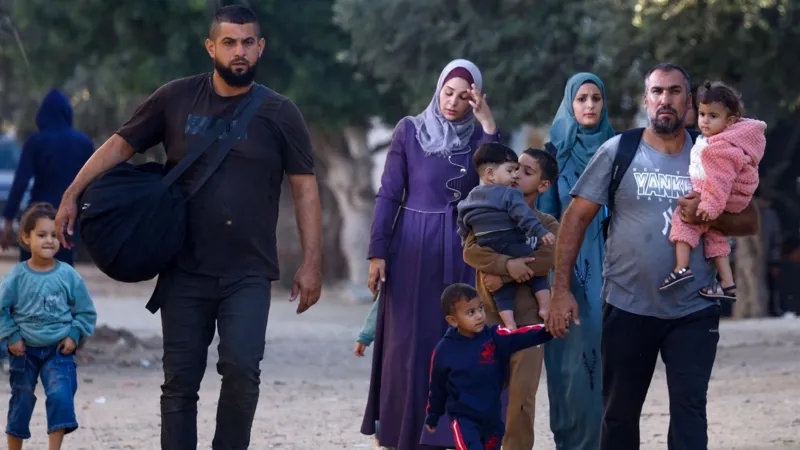
Israeli ground forces have launched a rare operation beyond the so-called Yellow Line in central Gaza, advancing towards areas near Nuseirat and Bureij refugee camps after issuing evacuation orders to Palestinian residents. The operation has renewed tensions over the October 2025 ceasefire agreement and forced more families from already overcrowded displacement areas.
According to the BBC, witnesses reported that Israeli tanks moved east of Nuseirat and onto sections of Salah al-Din road, Gaza’s main north–south route, while artillery fire was heard in the surrounding area. The Israeli military said the operation was intended to dismantle a tunnel west of the Yellow Line that it considered an immediate threat to its troops.
The Israel Defense Forces (IDF) said the operation was being conducted jointly with the Shin Bet security service. It maintained that its forces were operating in accordance with the ceasefire and would continue taking action against what it described as immediate threats. Hamas, which controls the parts of Gaza outside Israeli military control, condemned the advance as a “flagrant violation” of the agreement.
The Israeli military’s Arabic-language spokesperson, through the Coordination of Government Activities in the Territories (COGAT), warned residents in an area north of Nuseirat and Bureij to leave or stay away for their safety. Authorities also announced the closure of a section of Salah al-Din road passing through the affected area.
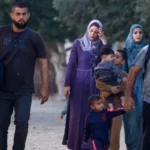
Videos published by Palestinian media outlets and on social media showed families leaving areas near Nuseirat. The BBC said its verification team had authenticated footage showing a man running along Salah al-Din road after artillery fire was heard. Another recording captured automatic gunfire in an area to the south-east.
Residents interviewed by BBC Arabic described leaving without basic belongings, including blankets, clothes and pillows. Some also reported shelling and gunfire near homes and makeshift shelters. These accounts underline the risks faced by civilians living in areas where military operations are taking place, although the full circumstances of reported casualties remain under investigation.
Gaza’s Hamas-run Civil Defence agency said three people were killed in separate Israeli drone strikes on Wednesday, in Nuseirat, Gaza City and Deir al-Balah. The IDF said it had struck several military operatives. The Israeli military did not provide a detailed response to the reported fatalities in the BBC account.
The latest operation comes amid continued violence since the ceasefire began in October 2025. Gaza’s Hamas-run health ministry says at least 1,658 Palestinians have been killed in Israeli attacks since the truce came into effect. The United Nations considers the ministry’s casualty figures reliable. The Israeli military, meanwhile, says six of its soldiers have been killed over the same period.
The Yellow Line marks the boundary separating areas under Israeli military control from the rest of Gaza. Israel occupies more than 60% of the territory, according to the BBC report. The latest advance west of that line has therefore raised questions about the practical limits of the ceasefire and the extent to which military operations can be conducted without undermining the agreement.
Hamas described the incursion and evacuation orders as a breach of the truce. Israel argues that its forces are entitled to act against immediate security threats. The competing positions reflect a wider dispute over how the ceasefire should be implemented, particularly while Israeli troops remain deployed across a substantial part of the territory.
The future of the ceasefire is closely tied to the unresolved question of Hamas’s weapons. The group has indicated that it would surrender its arms in exchange for a phased Israeli withdrawal from the areas under Israeli control. Israel, however, has insisted that Hamas must fully disarm before its forces withdraw.
The disagreement has become a major obstacle to the next stages of US President Donald Trump’s peace plan. Reconstruction has yet to begin on the scale required, while Gaza’s population continues to face severe shortages and widespread destruction.
The scale of the damage is considerable. An estimated 82% of structures across Gaza have been destroyed or damaged during the war, according to figures cited by the BBC. More than 1.9 million people—around 90% of the population—remain displaced, with approximately 1.4 million living in tents or makeshift shelters, according to the United Nations.
The conflict began after the Hamas-led attack on southern Israel on 7 October 2023, in which around 1,200 people were killed and 251 taken hostage. Since then, more than 74,700 Palestinians have been killed in Gaza, according to the territory’s health ministry.
The operation near Nuseirat illustrates the continuing vulnerability of civilians despite the formal ceasefire. Repeated displacement, damaged infrastructure and the absence of large-scale reconstruction have left many families with few safe places to move when evacuation orders are issued.
The central challenge is no longer limited to preventing a return to full-scale war. It also concerns whether the ceasefire can provide meaningful protection, enable humanitarian assistance and create conditions for reconstruction. As long as the parties remain divided over military withdrawal and disarmament, the truce will remain vulnerable to further confrontations.
For Gaza’s residents, the immediate consequences are tangible: renewed flight, disruption to movement and continued uncertainty over whether their homes and shelters will remain safe. The latest operation shows how quickly those conditions can deteriorate even while a ceasefire formally remains in place.
Sources: BBC, David Gritten, “Israeli military launches rare ground operation in Gaza beyond Yellow Line” (19 November 2026); United Nations Office for the Coordination of Humanitarian Affairs — Occupied Palestinian Territory; UNRWA — Gaza emergency; UN Secretary-General — Middle East.